EU STEM Coalition General Assembly to explore Europe’s STEM challenges
How can Europe strengthen STEM education and develop the skills needed for innovation and societal challenges? And what can countries, regions and organisations achieve together?
These questions will take centre stage at the EU STEM Coalition's General Assembly in Dortmund, Germany, from 11 to 13 November 2026. Hosted in cooperation with Coalition member zdi.NRW, the gathering will bring together STEM education organisations and stakeholders from across Europe.
 Programme at a glance
Wednesday, 11 November | Opening evening
The General Assembly will begin with a members' gathering, including updates on European STEM policy developments, the introduction of the Coalition's first EU STEM Ambassadors and discussions on future priorities. The evening will conclude with networking, poster presentations and opportunities to exchange experiences.
Thursday, 12 November | Members' meeting and public afternoon
The morning programme will focus on collaboration and shared learning among Coalition members. UNESCO representatives will contribute an international perspective on education, followed by parallel working sessions covering topics such as primary and secondary STEM education, AI, cooperation with industry and European partnerships.
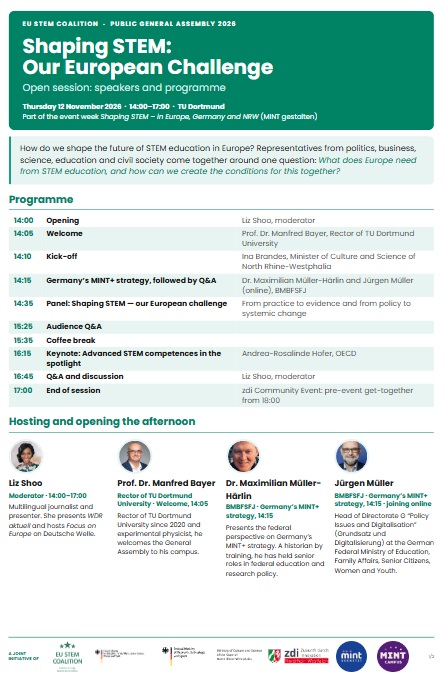
In the afternoon, the programme will open to a wider audience from the German and European STEM communities under the theme Shaping STEM: Our European Challenge. The public session, from 14:00 to 17:00, will feature contributions from policymakers, education and industry representatives, and an OECD keynote on advanced STEM skills.
Public afternoon: Shaping STEM: Our European Challenge
The public programme on Thursday, 12 November will take place at TU Dortmund University's International Meeting Center, with arrival from 13:30.
The afternoon opens at 14:00 with a welcome by Prof. Dr. Manfred Bayer, Rector of TU Dortmund University, followed by an opening address from Ina Brandes, Minister of Culture and Science of North Rhine-Westphalia.
Dr. Maximilian Müller-Härlin and Jürgen Müller will introduce Germany's MINT+ strategy, providing a national perspective on strengthening STEM education.
Five perspectives on Europe's STEM challenges
At 14:35, a panel discussion will explore how cooperation between education, government and industry can strengthen STEM pathways and help address Europe's skills challenges.
The panellists are:
-
Ina Brandes, Minister of Culture and Science of North Rhine-Westphalia, Germany
-
Doris Wagner, Head of the General Education and Vocational Training Section, Austrian Federal Ministry of Education
-
Elianne Demollin-Schneiders, Regional Minister, Province of Limburg, Netherlands, and member of the European Committee of the Regions
-
Patrick Graf, student at RWTH Aachen University, Germany, and former zdi participant
-
Markus Becker, Executive Director, System Economics, GE Vernova, and Chairman of GE Vernova's DACH Cross-Business Council
Moderated by journalist and presenter Liz Shoo, the discussion will bring together European, national and regional perspectives, including the experience of a student who previously participated in zdi activities.
OECD keynote: looking beyond graduate numbers
At 16:15, OECD education expert Andrea-Rosalinde Hofer will present the recently published report Policies for Developing Advanced STEM Skills in Higher Education.
Her keynote, Why producing more STEM graduates is not enough: A Policy Agenda for Europe, will examine why increasing graduate numbers alone is insufficient to address Europe's advanced STEM skills challenges.
Published on 23 October 2026, the OECD report identifies five interconnected challenges: entering STEM higher education, completing programmes, progressing to advanced levels, entering employment and using skills effectively, and renewing skills throughout working life.
It also highlights how recruitment practices, working conditions and the recognition of existing expertise can contribute to reported skills shortages.
The findings offer a starting point for considering how education, employment and innovation policies can work together more effectively.
Friday, 13 November | Closing day
The General Assembly concludes on Friday, bringing three days of exchange and European STEM cooperation to a close.
Practical information and registration
Public session: Thursday, 12 November 2026, 14:00–17:00 CET (arrival from 13:30)
Location: International Meeting Center, TU Dortmund University, Germany
Registration: Public General Assembly EU STEM Coalition
Further reading: OECD: Policies for Developing Advanced STEM Skills in Higher Education
 Formerly co-funded by the Erasmus+ Programme of the European Union

